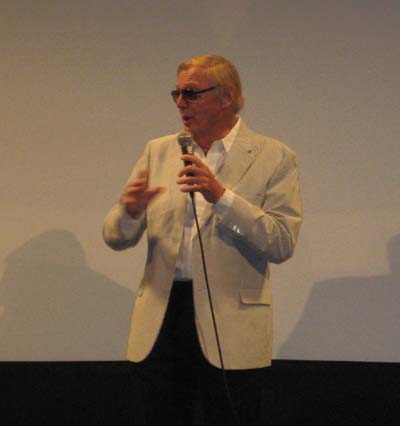
Taking questions as Batman, not as the Mayor of Quahog
Batman came full circle today and I’m talking about the 1966 movie, not Tim Burton’s 1989 best forgotten attempt. Recently, I learned about AC/DC’s first American show being here around 1977 and now it I get hit with this awesome fact…the world premiere of Batman was at the Parmount as repayment to the local company that built the Batboat! Pretty incredible because Austin was just a “sleepy” university town in the Sixties and Fox could’ve gone with major cities while the TV show was a hot property.
So Adam West returned to introduce his most famous movie along with being an honored guest for our recent traditional Bat Fest.
Quick explanation if you don’t about Austin’s famous two-million strong mammals. Underneath the Ann Richards Bridge (or Congress for the GOPers) are a kajillion Mexican free-tailed bats and there’s a colony under the McNeil Road exit along I-35 in Round Rock. Back in the 19th Century, before Pasteur’s findings were understood or believed (sound familiar?), many people around here died from malaria. It was a consequence of living in a warmer, muggy climate like DC, Houston, Miami, New Orleans, etc. Lack of air conditioning contributed too, hence the nation’s population shift doesn’t start until the Twenties. One remedy was to make the place attractive to bats. Sure, the “flying mice” are ugly, scary, transmit rabies and Count Dracula heightened their bad reputation but they eat mosquitoes; to the number of 600/day each. Few efforts worked to get them corralled to where they were wanted. Eventually other technologies solved the key problems to Southern living. Then the Congress Avenue Bridge was remodeled in 1980; it becomes Ann Richards after her death. Bats were generally found every bridge here and even nearby caves as Mike Rowe showed for his pilot of Dirty Jobs. After this remodeling, thousands flocked to the bridge. Somehow the new crevices were ideal roosting spots for the bats leading Austin to have the largest urban colony in the world. They make a bitchin’ mascot since the usual ones associated with Texas are predictable: horses, bulls, armadillos, cowboys and the dim-witted 43rd president.
Back to Bat Fest.
It’s usually a weekend filled with music, vendors, etc. Probably stuff to benefit the charity assisting the BCI (a conservation organization). With it being downtown, I tend to avoid it and the city deciding to make you pay for metered parking until midnight and Saturdays doesn’t help.
Having Adam West around to discuss this well-loved film provided the incentive to go for a change. The Paramount had a good print too, barely a scratch. He is looking pretty good as he approaches is 83rd birthday. Adam is also quite witty. Before he came on, he was introduced by Austin’s current mayor Lee Leffingwell to play up the Family Guy angle. Most questions were asked by pre-teens and children. My favorites:
- Will he have a cameo in the upcoming Dark Knight Triumphant as rumors said he was seen entering a London pub. (Probably to meet with British director Christopher Nolan, yet the movies are shot in Chicago.) Adam said, he’d heard that particular rumor but no, he was in London (recently) and was just going into a pub, nothing more. Nolan’s people have never contacted him. He wouldn’t mind though.
- What’s the weirdest line he ever had to say on the show? Catwoman, you cause unusual activity in my utility belt.
- The best…a four-year-old had his dad ask if the shark attack hurt? This made Adam smile and laugh, then he tried to show the scar on his leg. He assured the little boy it worked out as we all know what happened to the shark.
The Batcopter was supposed to be present but it’s stored in New Jersey and Hurricane Irene grounded it. Instead, a Texas-based collector brought the iconic Batmobile! APD cordoned off the stretch of Congress Avenue in front of the Paramount to show it! Batman’s wheels are even more impressive in person.
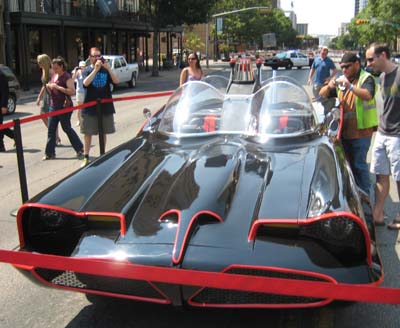
Batman's sweet ride in the Sixties.
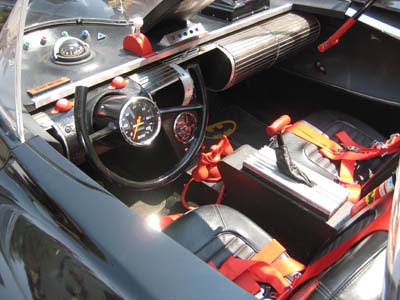
Here's all the cool interior stuff Batman and Robin see when driving, except for the compass on the dash, that reminds me of something silly Grandpa always installed in his cars.
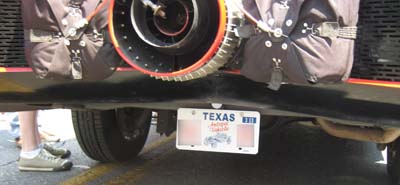
As you can see, the Batmobile is registered in Texas not Gotham City. The "bags" next to the jet exhaust are its drag chutes because this car is fast. Remember, it uses Atomic Power to get the Dynamic Duo places.





Back to Our Future by David Sirota
Book number three completed on the iPad!
Liberal/Left Wing columnist David Sirota (take your pick) makes a thoughtful introspection and analysis about how the Eighties™ continue to wield its influence over America. In short, he argues that its long-lasting impact has successfully pushed out the Fifties™, the most incorrectly recalled decade by conservative Americans; as Ned Flanders said, “I wish we lived in the place more like the America of yesteryear that only exists in the brains of us Republicans.”
Personally, every decade or era before “now” has left its imprint. Some wane because their “occupants” and adherents die out (Victorian America is practically extinct, pure pre-Civil War America is thankfully gone) while others such as the Nineties and Aughts were too recent, thus it’s too early to tell. I have always felt the Eighties™ started the process of officially erasing the lessons America learned with Vietnam. Sirota takes it beyond the political realm.
First is a quick explanation on Sirota’s use of ™ after the Eighties and Fifties. It’s how he separates the actual years from the time periods. I completely agree with this clarification. The Fifties technically ended when 1960 began. The Fifties™ ending? It could be Kennedy’s election (first president born in the 20th Century) or when the Beatles’ dominance over American youth culture started or any other time in between, maybe after. There’s no hard, clear demarcation yet I hope you see our point. The usage is also a jab at the marketing of decades, especially by politicians who peddle better versions of the past.
Back is nicely organized into five parts. Four examine the cultural-political-economic shifts. The fifth is a conclusion discussing the aftermath. The analysis can be pretty disheartening despite his fondness for the Eighties™; they were his formative years while there were mine too; I’m about eight years older (his bio says he graduated from college in 1998).
Here is the breakdown:
Contrary to how heavy those synopses sound, Sirota demonstrates a lighter nostalgic touch regarding these subjects than say Eric Alterman or Barbara Ehrenreich. The seriousness of the negative trends don’t get buried under the reminiscing though. Some points he makes weren’t new to me: the Pentagon’s successful post-Vietnam lies (the spat-upon vet is a favorite), the demonization of the poor (I’ve heard a young Republican recently claim they don’t pay any taxes) and everything the “gub’mint” touches turns to crap, except that claimants pork project or entitlement. Sirota did bring the racial matters more to light. Being “White” and male, I readily admit those things can escape my notice. I was pretty disgusted over how much pull the military-industrial complex has over films beyond Red Dawn. Then again, the studios are owned by corporations involved with making weapons, namely NBC-Universal, a division of General Electric.
I have to take issue over Sirota’s spiel regarding Michael Jordan’s career. The guy didn’t win any championships with the Bulls until the Nineties. Jordan’s scoring prowess during the Eighties quickly became a liability for his team. A great way to rile Chicago fans whenever they opened their mouths to brag would be this exchange I recall from college circa 1986-88.
Bulls Fan: Jordan scored 40 points last night!
Me: Yeah, but didn’t the Bulls lose by 20?
The Bulls’ domination in the Nineties (six titles) happened thanks to head coach Phil Jackson getting His Airness to buy into an offensive system which involved sharing the scoring (no more just-give-the-ball-to-Michael™) and acquiring more talented assistance. Scottie Pippen and Bill Cartwright readily come to mind. I’m not an expert on pro sports beyond being a fan and having an opinion. However, I do know that a team solely dependent on one star player will rarely make the playoffs. Sirota grew up in Philly. How could he “forget” our Flyers losing the Cup in 1985 and 1987 to the Oilers who were led by Wayne Gretzky. I emphasize the verb “led” since Gretzky couldn’t have done it without Phil Coffey, Mark Messier, Craig MacTavish and Grant Fuhr, just to name a few players. The 1990 Oilers then proved my point by hoisting the Cup sans Gretzky; the Great One was probably playing golf with his fellow Kings by mid-April. My point? The Ayn Rand-driven nonsense about individuals making all the difference always falls apart when used in the context of team sports. Jordan’s contribution to the Eighties™ was being a marketing puppet to shill underwear, hot dogs and overpriced shoes. He was exciting to watch yet the Lakers and Celtics were the most frequent champs (five and three respectively) in the Eighties. They were franchises which used teamwork, not exclusive dependency on Magic Johnson and Larry Bird.
Sorry if I diverted too long about sports. My nitpicking doesn’t totally invalidate Sirota’s point on the ugly trend promoting false heroes such as “the cop who plays by his own rules!” By now those stories are pretty cliche as entertainment. They continue to be swallowed whole in business and politics sadly. Part of Ayn Rand’s nonsensical ravings getting a revival through Teabaggers and RonPaulumpas.
Overall Back to Our Future is an amusing book. The level of detail and research Sirota put into it is amazing. Definitely a work he really threw himself into. Beyond historians, its audience may be limited to individuals born between 1965 to 1980. Older people probably don’t care and can’t completely relate. I won’t even guess with younger readers, maybe one will speak up, clue me in. I’m glad I followed this recommendation from my fellow Beulah Miners Alumnus Cindy. Now I await her two cents and possibly a clarification on the Bulls in the Eighties by Chicago superfan Paul, the roommate I often tormented when his teams lost.